How to use this glossary
Each definition is written for buyers, engineers and operators comparing equipment. Where a term relates to Lemico equipment, follow the link to the product page for configurations and specifications.
A
- Absolute Micron Rating
- The particle size at which a filter element removes essentially all particles in a controlled test, usually stated with a beta ratio. Stricter than a nominal rating. Related: Parts & Filter Elements →
- Additive Injection
- Metered dosing of fuel additives, such as static dissipator or fuel system icing inhibitor, into the fuel stream during loading or dispensing. Related: Blending Skids →
- Air Eliminator
- A device ahead of a meter that separates and vents air or vapour from the liquid so the meter measures only fuel. Related: Parts & Filter Elements →
- ASME Section VIII, Division 1
- The ASME Boiler and Pressure Vessel Code rules for designing, fabricating, inspecting and testing pressure vessels. Vessels built under it can carry the ASME U stamp. Related: Filter Vessels →
- ASME UM Stamp
- The ASME certification mark for miniature pressure vessels below set size and pressure limits. Related: Filter Vessels →
- ATA 103
- Airlines for America standard for jet fuel quality control at airports, widely used in the United States. Related: Aviation Fueling Equipment →
- ATA 103
- Airlines for America standard for jet fuel quality control at airports, widely used in the United States. Related: Aviation Fueling Equipment →
- AvGas
- Aviation gasoline for piston-engine aircraft. It is handled in dedicated, clearly identified equipment to prevent mixing with jet fuel. Related: Fuel Dispensing Cabinets →
- AvGas 100LL
- The most common aviation gasoline grade: 100 octane, low lead, dyed blue for identification. Related: Fuel Dispensing Cabinets →
- AvGas 100LL
- The most common aviation gasoline grade: 100 octane, low lead, dyed blue for identification. Related: Fuel Dispensing Cabinets →
B
- Bag Filter
- A filter vessel that uses a fabric bag as the filter media. Cost-effective for high dirt loads and pre-filtration. Related: Industrial Liquid Filtration →
- Basket Strainer
- A vessel with a removable perforated or mesh basket that catches coarse debris to protect pumps and meters. Related: Basket Strainers →
- Beta Ratio (β)
- The number of particles of a given size upstream of a filter divided by the number downstream. A beta ratio of 1,000 means 99.9% of those particles are removed.
- Bonding and Grounding
- Electrical connections between equipment, vehicles, aircraft and earth that equalize potential and safely drain static charge during fuel transfer. Related: Relaxation Tanks →
- Bottom Loading
- Filling a tank truck or railcar through connections at the bottom of the tank, reducing splash, vapour release and operator work at height. Related: Loading Arms →
- Bowser Cart
- A towable fuel tank with pump, filtration and metering, used to refuel aircraft or equipment where a full refueler truck is not needed. Related: Aviation Refuelers →
C
- Card-Lock System
- An access-control system that authorizes fuel dispensing with a card or key and records each transaction. Related: Fuel Dispensing Cabinets →
- Cartridge Filter
- A replaceable cylindrical filter element installed in a housing. Pleated, depth, coalescer and separator elements are all cartridge types. Related: Parts & Filter Elements →
- Category M (Cat M) Filtration
- The EI 1581 filter/water separator category for military aviation fuels such as JP-8, which may contain additives that disarm standard elements. Cat M elements are qualified for that service. Related: Military Refueling Skids →
- Chemical Water Detector
- A test capsule or paste that changes colour in contact with free water, used to check fuel samples before fueling. Related: Parts & Filter Elements →
- Chemical Water Detector
- A test capsule or paste that changes colour in contact with free water, used to check fuel samples before fueling. Related: Parts & Filter Elements →
- Clay Treater
- A vessel filled with clay media that adsorbs surfactants, colour bodies and other polar contaminants that can disarm coalescer elements. Related: Jet Fuel Filtration Vessels →
- Clear and Bright
- The visual standard for a fuel sample: free of visible water, sediment and haze, with a clean appearance. Related: Parts & Filter Elements →
- Clear and Bright
- The visual standard for a fuel sample: free of visible water, sediment and haze, with a clean appearance. Related: Parts & Filter Elements →
- Coalescer Element
- A filter element that merges tiny dispersed water droplets into larger drops heavy enough to settle out of the fuel. The first stage of a filter/water separator. Related: Filter Vessels →
- Controlled Goods Program (CGP)
- The Government of Canada program, administered by Public Services and Procurement Canada, that regulates who may examine, possess or transfer controlled military goods and technical data in Canada. Companies must be registered to take part. Related: Military & Defence →
- CRN (Canadian Registration Number)
- A registration number issued by a Canadian province or territory confirming that a pressure vessel or fitting design meets its safety requirements. Required before the equipment can be installed there. Related: Filter Vessels →
- Custody Transfer
- The point where ownership of fuel changes hands, where accurate, verified metering determines what is billed. Related: Volumetric Provers →
D
- Day Tank
- A small tank near a generator or engine that holds a short-term fuel supply, refilled from bulk storage by a transfer pump. Related: Diesel Pump Skids →
- Deadman Control
- A control that must be held by the operator for fuel to flow. Releasing it stops the flow immediately. Related: Hydrant Dispensers →
- Defueling
- Removing fuel from an aircraft or vehicle tank, for example for maintenance or to correct a load. Related: Aviation Refuelers →
- Differential Pressure (DP)
- The pressure drop across a filter. DP rises as elements load with dirt and is the main signal for when to change them. Related: Parts & Filter Elements →
- Dirt-Holding Capacity
- The amount of contaminant a filter element can retain before reaching its maximum allowable differential pressure. Related: Industrial Liquid Filtration →
- Dry-Break Coupling
- A quick-connect coupling that seals both halves before disconnection, so little or no fuel escapes. Related: Loading Arms →
E
- EI 1529
- Energy Institute standard for aviation fueling hose and hose assemblies. Related: Parts & Filter Elements →
- EI 1529
- Energy Institute standard for aviation fueling hose and hose assemblies. Related: Parts & Filter Elements →
- EI 1540
- Energy Institute guidance for the design, construction, commissioning, maintenance and testing of aviation fuel handling facilities. Related: Project Support →
- EI 1540
- Energy Institute guidance for the design, construction, commissioning, maintenance and testing of aviation fuel handling facilities. Related: Project Support →
- EI 1541
- Energy Institute standard for internal coatings used in aviation fuel handling equipment. Related: Jet Fuel Filtration Vessels →
- EI 1542
- Energy Institute standard for identification markings that show the aviation fuel grade on facilities and fueling equipment. Related: Aviation Refuelers →
- EI 1542
- Energy Institute standard for identification markings that show the aviation fuel grade on facilities and fueling equipment. Related: Aviation Refuelers →
- EI 1550
- Energy Institute handbook on equipment used to maintain and deliver clean aviation fuel. Related: Aviation Fueling Equipment →
- EI 1550
- Energy Institute handbook on equipment used to maintain and deliver clean aviation fuel. Related: Aviation Fueling Equipment →
- EI 1581
- Energy Institute specification and qualification procedures for aviation fuel filter/water separators, defining element categories and test requirements. Related: Jet Fuel Filtration Vessels →
- EI 1583
- Energy Institute test and performance requirements for aviation fuel filter monitors. Related: Jet Fuel Filtration Vessels →
- EI 1583
- Energy Institute test and performance requirements for aviation fuel filter monitors. Related: Jet Fuel Filtration Vessels →
- EI 1584
- Energy Institute standard for four-inch hydrant system components and arrangements. Related: Hydrant Dispensers →
- EI 1584
- Energy Institute standard for four-inch hydrant system components and arrangements. Related: Hydrant Dispensers →
- EI 1585
- Energy Institute guidance on cleaning aviation fuel hydrant systems. Related: Hydrant Pit Cleaner →
- EI 1585
- Energy Institute guidance on cleaning aviation fuel hydrant systems. Related: Hydrant Pit Cleaner →
- EI 1590
- Energy Institute specification and qualification procedures for aviation fuel microfilters. Related: Filter Vessels →
- EI 1590
- Energy Institute specification and qualification procedures for aviation fuel microfilters. Related: Filter Vessels →
- EI 1596
- Energy Institute requirements for the design, construction and testing of aviation fuel filter vessels. Related: Jet Fuel Filtration Vessels →
- EI/JIG 1530
- Quality assurance requirements for the manufacture, storage and distribution of aviation fuel to airports. Related: Aviation Fueling Equipment →
- EI/JIG 1530
- Quality assurance requirements for the manufacture, storage and distribution of aviation fuel to airports. Related: Aviation Fueling Equipment →
- Emulsified Water
- Very fine water droplets held in suspension in fuel. It can make fuel look hazy and usually needs coalescing to remove. Related: Diesel Filtration Vessels →
- Energy Institute (EI)
- The UK-based professional body that publishes many of the technical standards used for aviation fuel handling and filtration worldwide. Related: Jet Fuel Filtration Vessels →
- Energy Institute (EI)
- The UK-based professional body that publishes many of the technical standards used for aviation fuel handling and filtration worldwide. Related: Jet Fuel Filtration Vessels →
F
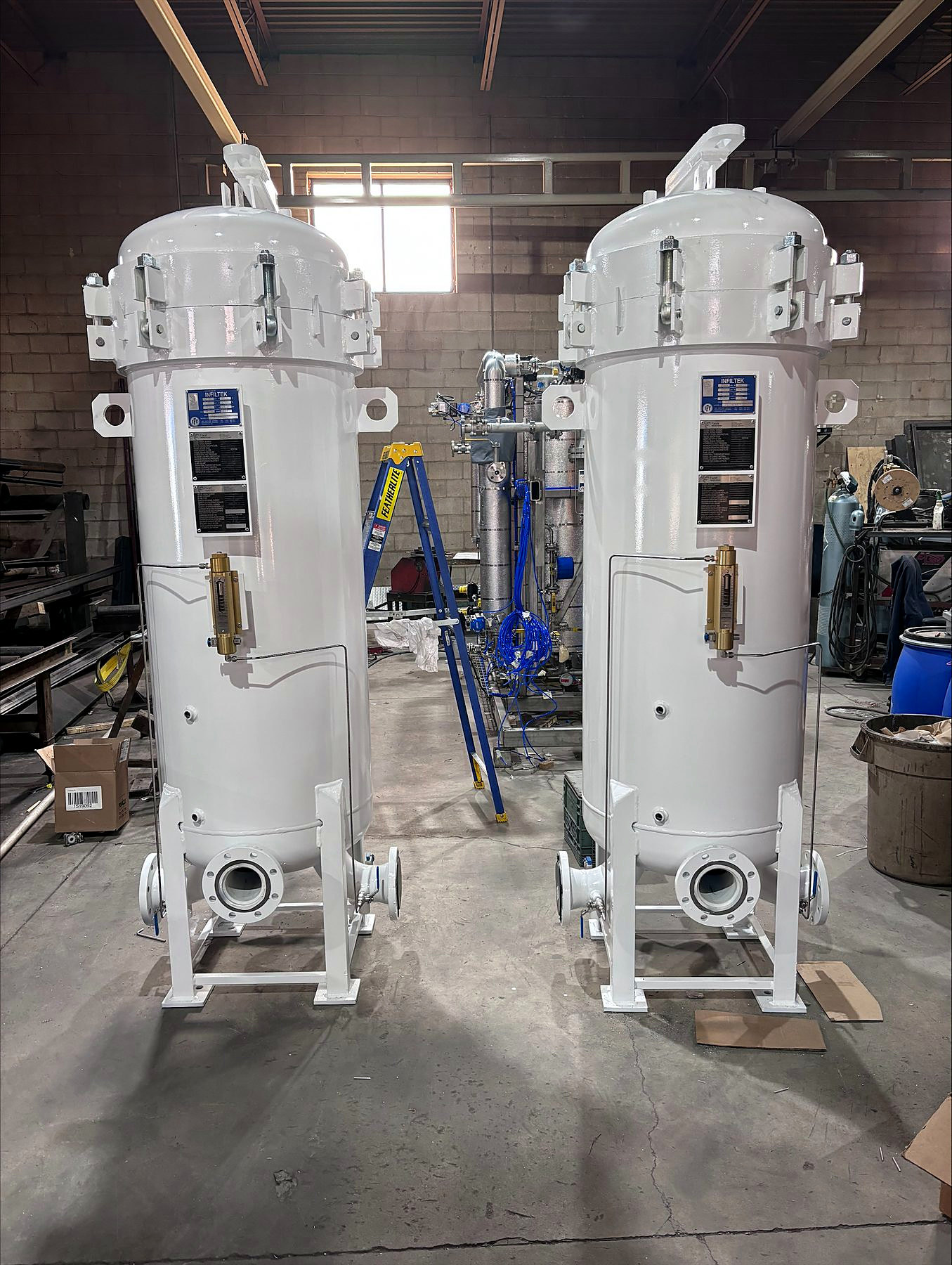
- Filter/Water Separator (FWS)
- A two-stage vessel: coalescer elements remove solids and merge water droplets, then separator elements stop coalesced water from passing downstream. Related: Jet Fuel Filtration Vessels →
- Floating Suction
- A tank outlet on a float that draws product from near the liquid surface, above settled water and sediment at the tank bottom. Related: Floating Suctions →
- Free Water
- Water present as separate droplets or a layer in fuel, which settles to low points such as tank sumps and filter vessel bottoms. Related: Diesel Filtration Vessels →
- Fuel Conductivity (pS/m)
- How easily fuel dissipates static charge, measured in picosiemens per metre. Low-conductivity fuels hold charge longer, which is why static dissipator additive and relaxation time matter. Related: Relaxation Tanks →
- Fuel Farm
- The airport's bulk fuel storage area, where fuel is received, settled, filtered and sent to hydrants or loaded into refuelers. Related: Aboveground Storage Tanks →
- Fuel Farm
- The airport's bulk fuel storage area, where fuel is received, settled, filtered and sent to hydrants or loaded into refuelers. Related: Aboveground Storage Tanks →
- Fuel Gas Conditioning
- Treating natural gas before it is burned, usually by filtration, liquid separation, heating and pressure regulation, so turbines, engines and burners receive clean, dry gas at a stable pressure. Related: Gas Skids →
- Fuel Grade Identification
- Colour-coded markings on tanks, piping, vehicles and nozzles that show which fuel grade each item handles, preventing misfueling. Related: Aviation Refuelers →
- Fuel Grade Identification
- Colour-coded markings on tanks, piping, vehicles and nozzles that show which fuel grade each item handles, preventing misfueling. Related: Aviation Refuelers →
- Fuel Polishing
- Recirculating stored fuel through filtration to remove water, sediment and microbial debris and keep it fit for use. Related: Diesel Filtration Vessels →
G
- Gas Filter Separator
- A two-stage pressure vessel that captures solids and coalesces liquid droplets out of a gas stream, collecting the liquid in a sump for draining. Related: Gas Skids →
H
- Haypack Coalescer
- A single-stage vessel packed with coalescing media, used upstream of finer filtration to remove gross amounts of water and solids. Related: Jet Fuel Filtration Vessels →
- Hydrant Dispenser (Hydrant Servicer)
- A vehicle or cart that connects to an airport hydrant pit and delivers fuel into aircraft through filtration, metering and pressure control, without carrying its own tank. Related: Hydrant Dispensers →
- Hydrant Pit
- An underground fueling point at an aircraft stand, connected to the airport's hydrant pipeline and fitted with a pit valve. Related: Hydrant Pit Cleaner →
- Hydrant Pit
- An underground fueling point at an aircraft stand, connected to the airport's hydrant pipeline and fitted with a pit valve. Related: Hydrant Pit Cleaner →
I
- In-Line Blending
- Combining two or more liquid streams continuously at a controlled ratio as they flow, using meters and control valves, instead of mixing batches in a tank. Related: Blending Skids →
- Into-Plane Fueling
- The final delivery of fuel into an aircraft, by refueler truck or hydrant dispenser. Related: Aviation Fueling Equipment →
J
- Jet A / Jet A-1
- Kerosene-type turbine fuels. Jet A-1 has a lower maximum freezing point (−47 °C) than Jet A (−40 °C), which suits it to international and long-haul flights. Related: Aviation Fueling Equipment →
- JIG
- Joint Inspection Group: industry standards for the safe handling and quality control of aviation fuel at airports and depots. Related: Aviation Fueling Equipment →
L
- Loading Arm
- An articulated arm with swivel joints that connects a loading rack to a tank truck, railcar or vessel for top or bottom loading. Related: Loading Arms →
M
- Microbial Contamination
- Bacteria and fungi that grow at the fuel–water interface in tanks, forming sludge and acids that plug filters and corrode equipment. Related: Diesel Filtration Vessels →
- Micron (µm)
- One thousandth of a millimetre. Filter ratings are stated in microns; a human hair is roughly 50 to 100 µm thick.
- Micronic Filter
- A fine particulate filter, typically rated at a few microns, used to protect meters, valves and downstream equipment and to polish fuel. Related: Filter Vessels →
- Misfueling
- Putting the wrong fuel grade into an aircraft, such as jet fuel into a piston engine. Prevented with dedicated equipment, grade markings and nozzle types. Related: Fuel Dispensing Cabinets →
- Misfueling
- Putting the wrong fuel grade into an aircraft, such as jet fuel into a piston engine. Prevented with dedicated equipment, grade markings and nozzle types. Related: Fuel Dispensing Cabinets →
N
- NFPA 407
- The NFPA standard for aircraft fuel servicing, covering fueling vehicles, hydrant systems, bonding and safe fueling practice. Related: Aviation Refuelers →
- Nominal Micron Rating
- A filter's approximate particle retention size, usually meaning a stated percentage of particles at that size are captured. Less strict than an absolute rating. Related: Parts & Filter Elements →
O
- Overwing Fueling
- Fueling through an open filler cap on top of the wing with a nozzle, common for smaller aircraft and AvGas. Related: Aviation Refuelers →
P
- Positive Displacement Meter
- A flow meter that measures fuel by repeatedly filling and emptying chambers of known volume, giving high accuracy for fueling and custody transfer. Related: Volumetric Provers →
- Pressure Relief Valve (PRV)
- A valve that opens automatically to protect a vessel or piping from pressure above its design limit. Related: Filter Vessels →
- Product Recovery Tank
- A small tank that collects fuel drained during sumping of filter vessels and storage tanks, so clean product can settle and be returned to storage rather than discarded. Related: Filter Vessels →
- Pump Skid
- A pre-assembled package of pumps, piping, valves, meters and controls mounted on a common steel base, shipped and installed as one unit. Related: Diesel Pump Skids →
R
- Refueler
- A truck or trailer with its own fuel tank, filtration, metering and hose reels, used to fuel aircraft away from a hydrant system. Related: Aviation Refuelers →
- Relaxation Tank
- A pressure vessel after the filters that holds fuel long enough to provide the required relaxation time in a compact footprint. Related: Relaxation Tanks →
- Relaxation Time
- Time allowed after filtration for static charge in fuel to dissipate before it enters a tank or space with vapour. Commonly around 30 seconds. Related: Relaxation Tanks →
S
- Separator Element
- A water-repellent element in the second stage of a filter/water separator that lets fuel pass but stops coalesced water drops. Related: Filter Vessels →
- Single-Point Refueling
- Pressure refueling of all aircraft tanks through one standardized coupling under the wing, controlled by the aircraft's fuel system. Related: Hydrant Dispensers →
- Single-Point Refueling
- Pressure refueling of all aircraft tanks through one standardized coupling under the wing, controlled by the aircraft's fuel system. Related: Hydrant Dispensers →
- Skid
- A welded steel base that carries process equipment so it can be built, tested and shipped as a single package. Related: Aviation Skids →
- Slop Tank
- A tank that collects drained, sampled or off-specification fuel and water for later disposal or reprocessing. Related: Hydrant Pit Cleaner →
- Static Dissipator Additive (SDA)
- An additive that raises fuel conductivity so static charge drains away faster during pumping and filtration. Related: Relaxation Tanks →
- Sump
- The low point of a tank or vessel where water and sediment collect so they can be drained and sampled. Draining it is called sumping. Related: Filter Vessels →
- Surfactant
- A surface-active contaminant that stabilizes water in fuel and can disarm coalescer elements. Often removed with clay treatment. Related: Jet Fuel Filtration Vessels →
- Sustainable Aviation Fuel (SAF)
- Renewable jet fuel made from sources such as waste oils or biomass, blended with conventional jet fuel before use. Related: Aviation Fueling Equipment →
- Sustainable Aviation Fuel (SAF)
- Renewable jet fuel made from sources such as waste oils or biomass, blended with conventional jet fuel before use. Related: Aviation Fueling Equipment →
- Swivel Joint
- A rotating pipe joint that lets loading arms and floating suctions move while keeping a sealed flow path. Related: Loading Arms →
T
- Transloading
- Transferring bulk liquid between transport modes, such as from railcar to truck or railcar to storage tank. Related: Rail Fueling & Transloading →
U
- UL 142 / ULC-S601
- Standards for shop-fabricated steel aboveground tanks for flammable and combustible liquids: UL 142 in the United States and ULC-S601 in Canada. Related: Aboveground Storage Tanks →
- Underwing Fueling
- Pressure fueling through a coupling under the wing, used for larger aircraft at higher flow rates. Related: Hydrant Dispensers →
V
- Volumetric Prover
- A precisely calibrated vessel of known volume used to check and adjust the accuracy of fuel meters. Related: Volumetric Provers →
W
- Water Slug Valve
- A valve on a filter/water separator that closes when water in the sump reaches a set level, stopping flow before water can pass downstream. Related: Jet Fuel Filtration Vessels →
Keep Exploring
Related equipment and support that often goes with this page.
Need help choosing equipment?
Send us your fuel, flow rate and application and our team will recommend the right configuration.